




In April, we published our first CFO survey examining AI adoption in the finance suite. At the time, we found that AI tools were stuck in proof-of-concept deployments in most organizations.
Our survey turned out to be timely: A few weeks after we completed it, Anthropic released its groundbreaking Opus 4.7 product, which represented a step-function improvement over other available AI models at the time. As a result, we saw the rate of AI adoption amongst finance professionals in our portfolio dramatically accelerate.
In August, we checked back in with buyers and users of AI tools in the CFO suite, and we found things have significantly changed in a very short timeframe. Our second survey shows AI is becoming ingrained in many finance workflows and AI-native vendors are singlehandedly leading the charge on delivering the promise of AI to CFOs.
From POC Bottleneck to Mission Critical
This survey queried 50 finance professionals, mostly CFOs and VPs of finance at a range of organizations. A little less than half of the executives worked for B2B software companies and about a quarter in healthcare or life sciences; most of their organizations employed between 100 and 499 people.
Most importantly, the survey results confirmed AI is no longer a science experiment for CFOs. Today, 88% of the CFOs in our survey reported having AI deployed inside their organization, up from just 17% just six months ago.
Why might this be? If you re-wind to six months ago, when we sent out our first survey, we found two big concerns buyers had that were preventing further AI adoption—but they now appear to have been resolved.
The first was model accuracy, which was cited as a concern by 71% of respondents six months ago. We noted at the time that if models continued to improve according to standard scaling laws, then accuracy soon wouldn’t be a problem. Sure enough, Mercor earlier this month released a study showing AI models now outperform junior accountants on month-end close tasks. Clearly, models are finally at a point where they can do real accounting work and can give humans real leverage.
The second barrier to mass adoption mentioned in April was data readiness. Thanks to a maturing application layer, we’re now seeing CFOs tackle this issue head on, primarily by consolidating fragmented and legacy tool stacks onto modern systems of record built for the AI era. Our portfolio company Rillet*, which makes an AI-native ERP product, serves as a great example of what buyers are looking for: first, a clean data substrate that can give models complete information and context to get jobs done, and second, the ability to create and orchestrate agents to do that work. Already, eight percent of CFOs we surveyed most recently believe agents are mission-critical to their finance processes, and we see that number increasing meaningfully by the end of this year.
Battle for the Finance AI Interface
Where and how are these finance-focused agents getting built? This is an important question because the race today in AI is the race to own inference, in which AI models actually analyze data and take action. We believe the finance-suite vendors who own the best agents will be able to monetize tokens, and not just software. These vendors will be able to grow their revenue by tapping into large corporate budgets for human labor over time, expanding their market size from existing budgets for enterprise-resource planning (ERP) and related financial software.
Today, finance agents are largely getting built in general-purpose harnesses like Claude Cowork or ChatGPT Codex—call these “horizontal models”, versus vertical or even proprietary, company-specific models. Right now, CFOs are playing it safe: AI has spread fastest where the workflows are the simplest and horizontal models suffice. This also happens to involve the workflows where audit consequences are lowest: FP&A forecasting, management reporting and accounts-payable automation top the list. Stated another way, the workflows using the most AI are the ones a horizontal model can serve without touching the ledger.
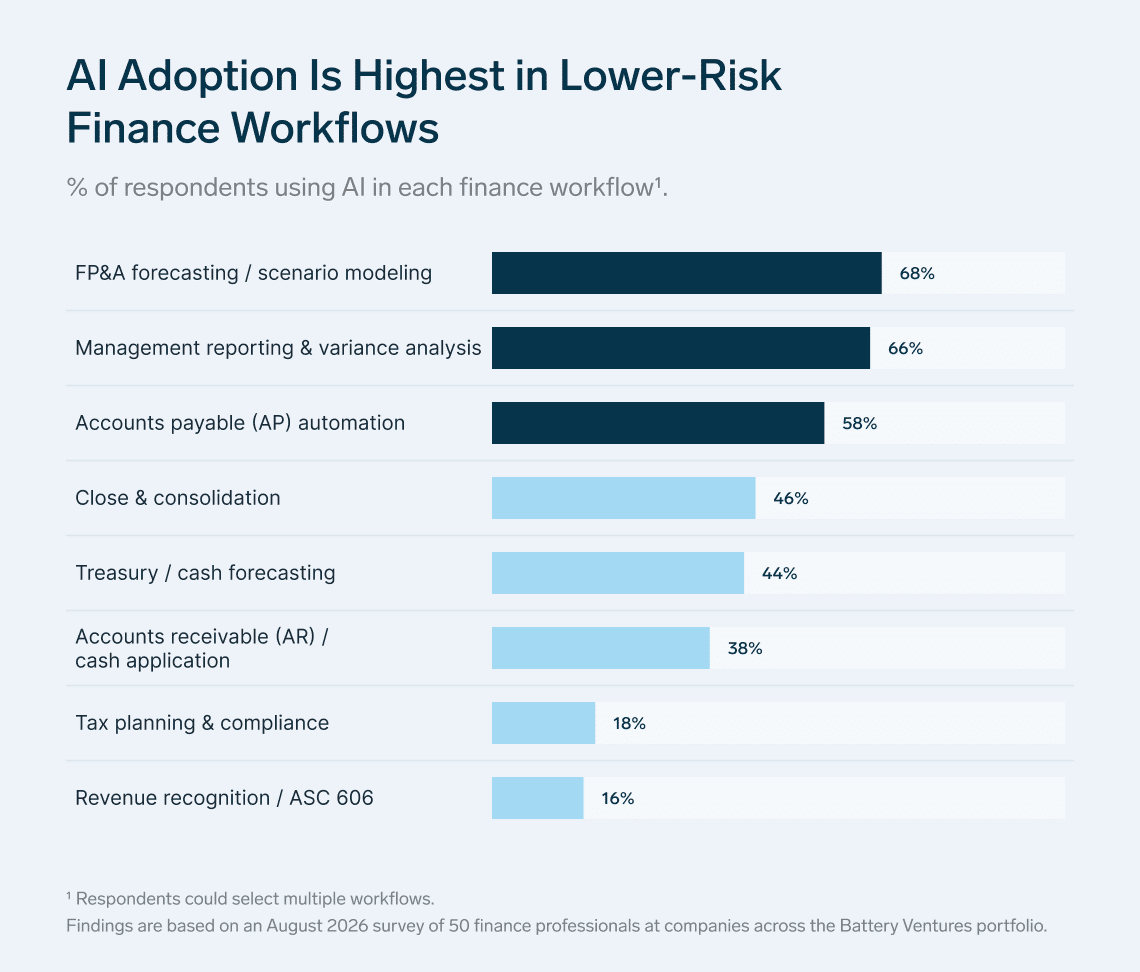
By contrast, more complex and sensitive workflows like revenue recognition and tax planning and compliance are the least penetrated by AI. These are also the most sensitive, audit-bound workflows where finance leaders typically have no margin for error. Unsurprisingly, these are exactly the types of workflows CFOs believe require native, in-ERP AI. Put differently, the more audit-bound a workflow is, the more likely CFOs are to require native finance agents to tackle it, and the least likely they are to be already using horizontal AI. This is illustrated in the chart below, which shows each finance workflow by horizontal AI penetration as well as belief that each requires native in-ERP AI.
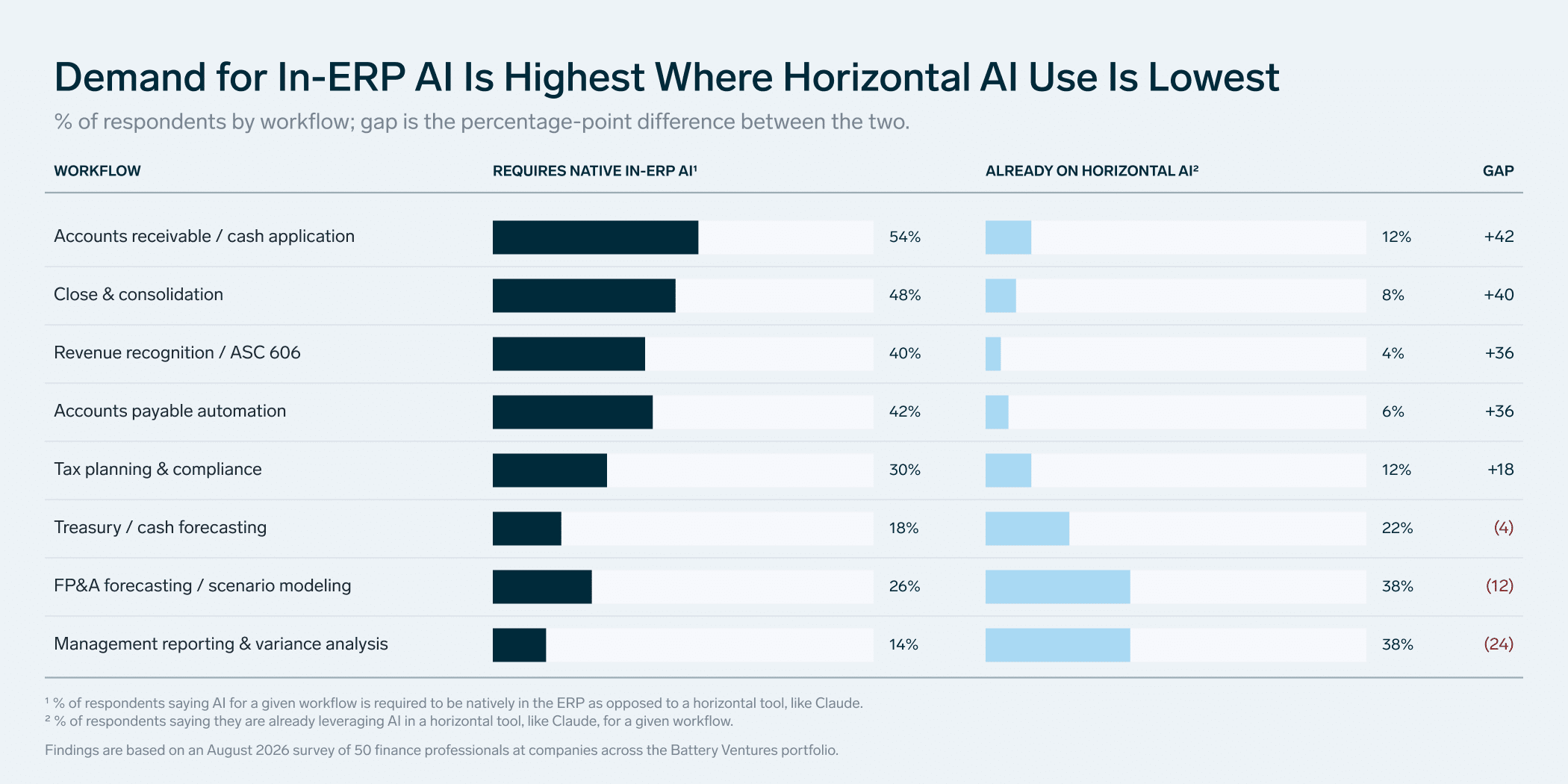
In addition to revenue recognition and tax noted above, CFOs believe AI automation for accounts receivable, close/consolidation and accounts payable need to be built into core accounting systems that maintain governance, control and compliance. As such, our belief is that as purpose-built finance harnesses get better over time, more finance teams’ agent use will live natively in finance-specific systems.
Clearly CFOs are iterating on what works best for them as the underlying technology continues to evolve. This bleeds from the workflow down into the model layer, where there is not much standardization: 84% of CFOs in our survey said they run two or more models while 28% run four or more. Cost is also taking the backseat to capability and finding effective automation. Model performance is the single most important selection factor for 64% of buyers, ahead of auditability at 20%. Only 16% of respondents said they actively manage token costs today, while a much-larger 86% report they will in a year from now.
Nobody ever got fired for buying IBM. Now they might.
Perhaps the most striking finding in this survey relates to incumbent ERP providers and their oldest defense against replacement: credibility and lock in.
For thirty years, the reason to buy a big, incumbent ERP was that it was the safe choice. Nobody ever got fired for buying IBM, and for a long stretch the same logic protected the large incumbent ERPs like Oracle NetSuite and Sage Intacct: a large installed base, audit history and vendor longevity constituted the whole pitch, and the pitch worked because a failed ERP migration could torpedo a CFO’s career. One respondent in our first survey put it bluntly: ERP changes tend to be career-limiting moves.
Our April survey saw a clear trend of layering AI on top of ERPs (77% of respondents were doing it) versus purchasing AI-native (15%). That calculus has inverted. When buyers now rank what matters to them in a next-generation finance platform, native AI and agentic automation top the list, along with auditability and controls. And this sentiment is shared across CFOs who bought incumbent as well as AI-native ERPs. Vendor stability and track record ranks dead last in terms of priorities. The incumbent moat is not being outcompeted; it is being ignored. Worse still, incumbency may now be a liability: In buyers’ eyes, a vendor’s tenure is negatively correlated with how modern its technology is.
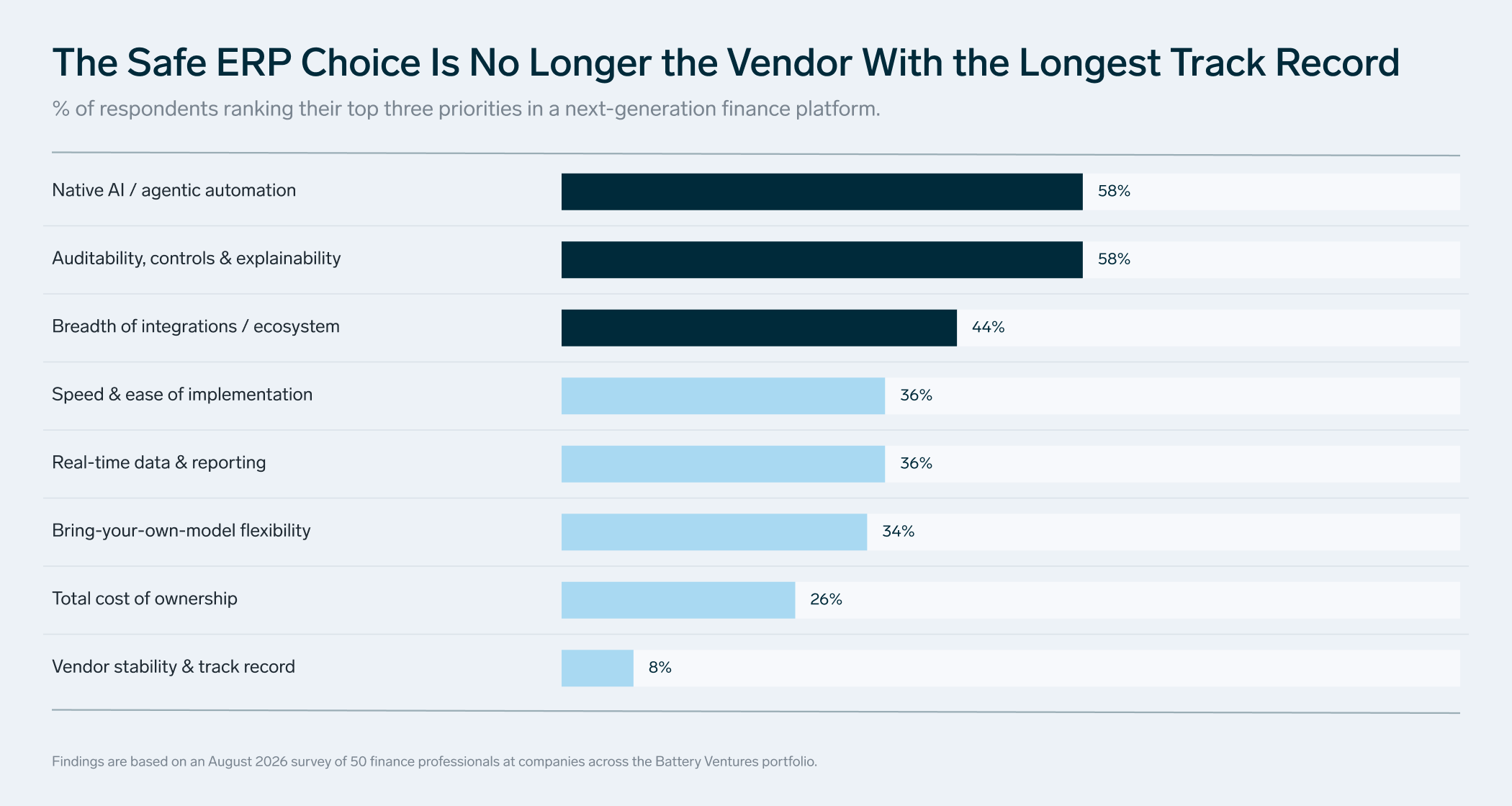
Think about what that means for a CFO in 2026. The safe choice is no longer the established software vendor with the long track record; CFOs now are being rewarded for injecting AI effectively into their organizations. So their incentive is to buy the system that can credibly govern agentic work, even if that vendor is young and the product is not fully proven. The career risk for CFOs has flipped from conservatism to modernism: No CFO wants to explain to a board why their finance function is three years behind.
At this turbulent moment, most of the CFOs we surveyed believe AI-native ERPs can map the future more clearly than legacy providers. Confidence in vendor roadmaps is much higher among finance pros using AI-native systems today than it was six months ago: A full 65% of AI-native customers rated their vendor’s delivery on their AI roadmap as a four or five on a scale of five, in terms of importance, while only 15% of finance pros with legacy systems gave the same rating. This matters because buyers understand we’re early in the AI adoption journey and they’re not just buying an ERP system for what it is today, but for what it will become years from now. Their ERP isn’t just a software provider, but an AI thought partner.
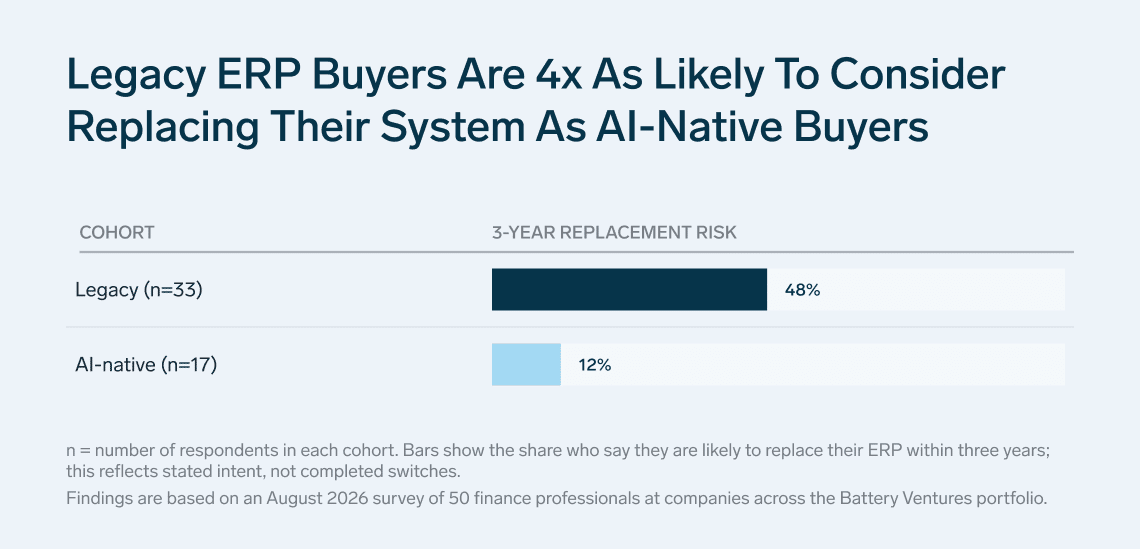
The implication behind this credibility gap is a continued shift from legacy to AI-native systems of record, which we wrote about extensively here. What should alarm ERP incumbents is that 48% of legacy buyers say they are likely to replace their ERP within three years, compared with only 12% of AI-native buyers. Four-to-one turnover in a category defined by its stickiness is not something we often see. About 30% of legacy buyers we surveyed would switch ERPs for a compelling AI-native alternative; zero of the AI-native buyers felt the same way.
Where Will We Be in Six Months From Now?
The big question left for us is, where will we be in six months from now? One thing is clear: the pace of change with AI is only accelerating. In the last six months, AI in the CFO suite broke out of its POC bottleneck and is approaching mission criticality. The level of that adoption varies across workflow, which we believe reflects category nascency. The other shift is what buyers value, which is native and auditable AI. Vendor stability has not only been deprioritized; it ranks dead last and may even be getting ignored.
Put together, we think the biggest story here is that the shape and nature of the finance profession is changing in real time. If spreadsheets made finance faster, AI agents might turn finance professionals into builders.
The information contained here is based solely on the opinions of Aaron Neil, Michael Brown, Alex Auchter, Matt Dailey, and Genki LeClair, and nothing should be construed as investment advice. This material is provided for informational purposes, and it is not, and may not be relied on in any manner as legal, tax or investment advice or as an offer to sell or a solicitation of an offer to buy an interest in any fund or investment vehicle managed by Battery Ventures or any other Battery entity.
This information covers investment and market activity, industry or sector trends, or other broad-based economic or market conditions and is for educational purposes. The anecdotal examples throughout are intended for an audience of entrepreneurs in their attempt to build their businesses and not recommendations or endorsements of any particular business.
*Denotes a Battery portfolio company. For a full list of all Battery investments, please click here.












A monthly newsletter to share new ideas, insights and introductions to help entrepreneurs grow their businesses.