




The AI conversation in enterprise technology has been almost entirely about software—models, APIs, agents, workflows. Physical AI is a different category—encompassing robotics, autonomous vehicles, edge AI devices and smart sensors—and by most measures, a category that’s still quite new and immature. But signals from our recently released survey data suggest the gap between “early” and “mainstream” may be much shorter than it appears.
When we asked 100 enterprise technology leaders at large enterprises (1,000 – 5,000+ FTEs) whether their organizations are currently implementing or piloting physical AI, a surprising 26% reported some form of active engagement today: 13% had projects in research and development, seven percent were piloting, and six percent had already deployed physical AI in production. Another 23% of respondents said they’re not yet active but plan to explore physical AI within 12 months.
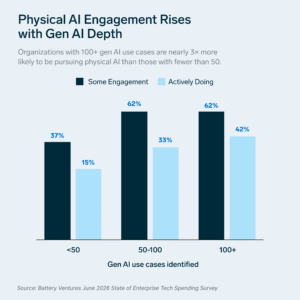
It’s perhaps telling that the companies going deepest on generative and agentic AI are also the ones pursuing the next wave. Organizations with 100+ gen AI use cases are nearly three times as likely to be working on physical AI (42% of respondents) as those with fewer than 50 use cases (15% of respondents).
Who owns physical AI strategy is still an open question. Thirty-five percent of respondents said their CTOs were owning it, 27% said CIOs were in charge versus eight percent of organizations said there was no clear owner at all. This is surprising for a technology category that involves real-world infrastructure, safety implications and significant capital expenditure. Notably, the COO—who arguably has the most operational exposure in manufacturing and logistics use cases—owns the strategy in only eight percent of organizations, suggesting governance accountability may lag deployment.
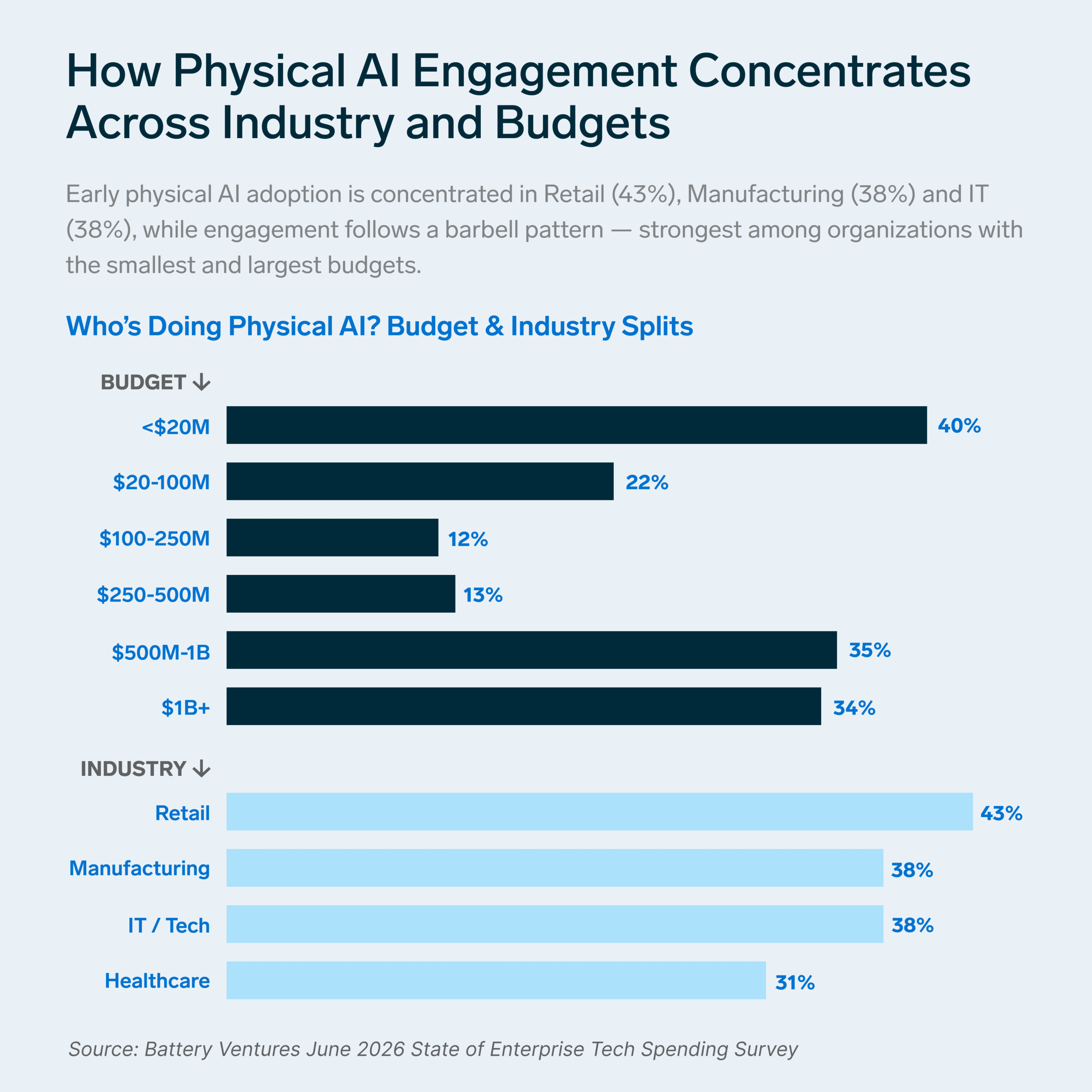
True, physical AI remains a small part of corporate enterprise technology budgets. Among the 49% of enterprises with plans to experiment or deploy physical AI, the industry breakdown tells a more textured story. Only 38% of manufacturing and information/technology companies are actively engaged with physical AI, while 43% of retail companies are.
Edge AI is actually furthest along, with robotics trailing (despite the hype)
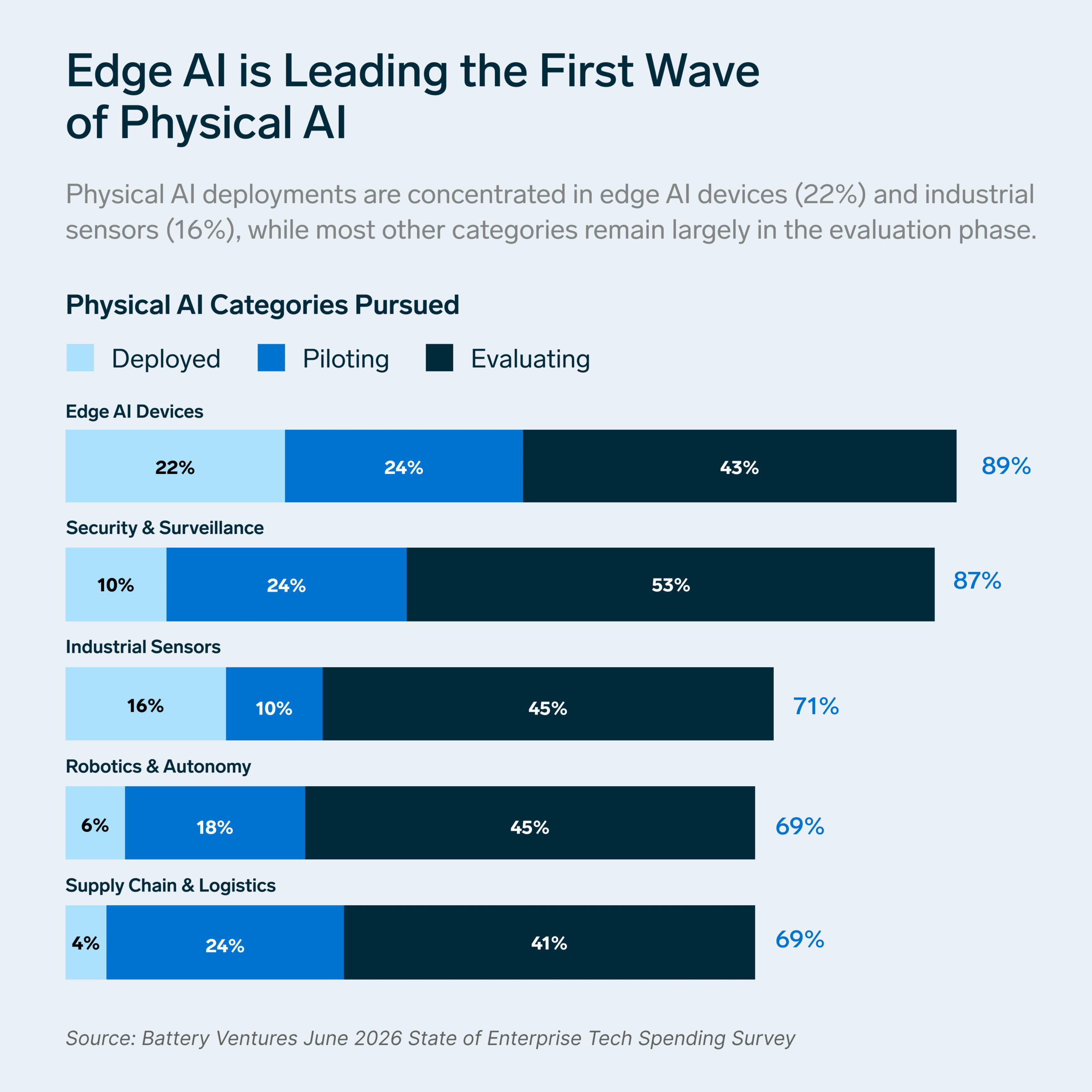
Across the five physical AI categories we tracked, edge AI devices have the most active deployment today. This category encompasses AI hardware that processes data locally on the device itself—rather than sending it to a central server—allowing sensors to infer and react to information in real time. In our survey, 23 organizations said they are actively piloting or deploying edge AI, including 11 that said they currently have physical AI deployed in production. AI-enabled security and surveillance (smart cameras, access control) is the next-most popular subcategory, with 17 organizations actively engaged.
Robotics and autonomous systems, which dominate the public narrative around physical AI, are actually not that prevalent in practice. Only 12 organizations in our survey are actively piloting or deploying robotics, and just three have reached production deployment. The enthusiasm for robotics is real—22 respondents are evaluating it—but the gap between evaluating and deploying reflects the genuine complexity involved. In full disclosure, it may also reflect the composition of our survey cohort: Finance & insurance is our second-largest industry category, while information / technology is our largest.
Thirteen respondents are actively engaged with industrial sensors and predictive maintenance, arguably the most operationally mature physical AI category, including eight organizations in production—the highest production deployment rate of any category. For manufacturing and logistics-heavy organizations, this is where physical AI is paying off today.
Where physical AI is showing up in the real world
The most compelling use cases share a pattern, according to our survey: hardware generating proprietary data that software alone could never access. In the industrial sector, steel mills are deploying sensor networks across factory floors to optimize raw material consumption in real time. In complex facilities, AI agents ingest live sensor and visual data to autonomously adjust control logic, optimizing yield, throughput and energy consumption without human intervention. In logistics, AI-enabled camera towers at warehouse loading docks automatically verify existing freight, and roadside sensor networks are improving supply-chain visibility and combating freight fraud. In agriculture, tractor-mounted robotic systems use computer vision to target individual weeds and perform precision thinning, cutting both labor and chemical costs at scale. The hardware creates a proprietary data moat that software-only competitors can’t easily replicate.
What’s blocking broader adoption of physical AI
The barriers to physical AI are different in character than the barriers to software AI. Among enterprises already engaged with physical AI, 69% of respondents cited integration complexity with existing systems as a barrier, reflecting the challenge of connecting intelligent hardware to legacy enterprise infrastructure. Fifty-nine percent of respondents cited hardware and infrastructure costs, followed closely by security and safety concerns cited by 55%.
Forty-seven percent of respondents said that unclear ROI was a key barrier—notable because it mirrors the challenge we see across the broader AI landscape, where the business case for new technology categories is still being written in real time.
Physical AI’s workforce story is still being written
Of respondents thinking about using, or currently using physical AI, 39% said physical AI will primarily augment human workers, with humans remaining central in their operations. The majority expect a balanced mix of augmentation and some human-role replacement in physical and operational tasks, with only six percent expecting the primary use of the technology to be human replacement. That’s consistent with the broader augmentation narrative across this report. But physical AI is the one domain where replacement of physical labor is genuinely on the table in ways that software AI is not.
The physical layer of enterprise AI is early. But edge devices are already in production, industrial sensors are delivering ROI in manufacturing environments and a wave of organizations are moving from “no plans” to “actively exploring” physical AI within the next year. For the software vendors and infrastructure providers building adjacent to this category, the opportunity window is opening.
This post is in parallel with Battery’s 2026 Enterprise Spend Report series. Download the full report here.
The information contained here is based solely on the opinion of Nick Elsner, Michael Hoeksema, Hailey Wilcox and Scott Goering and nothing should be construed as investment advice. This material is provided for informational purposes, and it is not, and may not be relied on in any manner as legal, tax or investment advice or as an offer to sell or a solicitation of an offer to buy an interest in any fund or investment vehicle managed by Battery Ventures or any other Battery entity.
This information covers investment and market activity, industry or sector trends, or other broad-based economic or market conditions and is for educational purposes. The anecdotal examples throughout are intended for an audience of entrepreneurs in their attempt to build their businesses and not recommendations or endorsements of any particular business.
*Denotes a Battery portfolio company. For a full list of all Battery investments, please click here.










Join the Battery mailing list
From company-building insights to the latest research and perspectives from Battery, stay informed on the topics that matter most to you.